
Cinema Dispatch: 2021 Catch Up (Part 2)

January is still proving to be a rough month across the board, so we’re gonna continue our look back 2021 with a few more movies that I missed!  Will some of them be contenders for the end of the year lists I’ll be putting together very soon?  Let’s find out!!

.

Being the Ricardos

Being the Ricardos is owned by Amazon Studios

Directed by Aaron Sorkin

Lucille Ball (Nicole Kidman) and Desi Arnaz (Javier Bardem) are about to have a rough week making their show I Love Lucy when a local news station accuses Lucille of having ties to the Communist Party.  Couple that with tabloids about Desi’s behavior, fights with the network over content, and a director that really gets under Lucille’s skin, and there may not be a show to put on by the time it goes to air!  Can Lucy and Desi smooth through all of these problems without alienating the people who help them make the show, and is there more at stake than their careers if things go badly?

Aaron Sorkin has always been fascinated with the inner workings of organizations that carry a lot of public weight; places where hiding the turmoil behind the scenes is just as important as anything else they are doing.  It seems almost natural that he’d turn that fascination even more inward with a movie about the field he’s most familiar with, television productions, and while there are some Sorkin-esque flaws in this movie, I think the material has steered him into making one of his best works.  Lucy and Desi, at least as they are portrayed in this movie, are fascinating characters with deeply compelling inner lives, and the movie makes no bones about singing their praises throughout.  Whenever they clash with the network over their creative vision for the show, it’s played with reverence as these victories did end up revolutionizing television and American culture, and Sorkin definitely uses this story to indulge in his favorite topics.  Strong men and women with sharp tongues and even sharper wits sticking it to the old guard to make way for the next generation is well-worn territory for him, but the fact that he’s drawing from real things that other people did tempers that enthusiasm and so it comes off as genuinely important rather than mere wish fulfillment.  Now that’s not to say he doesn’t exaggerate in places as the film does lack a certain sense of authenticity.  Clothing, technology, and even a lot of the attitudes do fit in with the time period, but it never quite feels like a period piece with Sorkin’s dialogue being what it is, and the overall look and feel of the show just feels too modern.  I don’t know if there are HD transfers of I Love Lucy, but I’m guessing they don’t look this crisp and they certainly weren’t shot in widescreen.  Still, even if it’s a bit showy in places where it probably wasn’t in the real-life story, Sorkin’s overly enthusiastic style fits with themes of the movie and his specific brand of dialogue creates a clear delineation between the deep and flawed people who make the show and the more modest caricatures they bring to life in front of cameras.  This is where the movie shines brightest, where these two people are darn near Herculean in their ability to solve problems, fight for what’s important, and smooth talk their way to getting what they want, but at the end of the day, when the cameras stop rolling and the lights turn out, they are still flawed people barreling towards an ending they are too scared to face.  Desi is madly in love with Lucille and Lucille is just as passionate about him, but Desi also can’t help but hurt her in ways that she cannot ignore.  This tension between the genuine love they feel and their uncontrollable selfishness (admittedly much more so with Desi than Lucille) is where the tragedy of this story ultimately lies and where the story is at its strongest.  This ends up being a double-edged sword however as the movie feels the need to be about more than just that and so it feels a bit scattershot and overstuffed with subplots and characters that don’t have the impact you would expect them to given the prominence of certain scenes.  The big red elephant in the room is the Communist allegations which are what kicks off the movie and you assume it’s what the whole thing is going to be about, but that ends up fading into the background as the network stuff and the relationship between Lucy and Desi end up pushing it to the background. It ends up being relevant only to the start and the end of the movie which is a bit of a shame as the fervor surrounding communism in the mid-twentieth century is certainly a frightening chapter in television history, but it at least ends on a very strong note and sets us up for a pretty big gut punch right at the end of the movie.  It’s certainly a flawed movie throughout, but it’s entertaining from the first frame to the final curtain call, and frankly, something that walks with confidence is more interesting to me than something safe; even if the former trips over itself a few times along the way.

4 out of 5
Continue reading “Cinema Dispatch: 2021 Catch Up (Part 2)”

Cinema Dispatch: 2021 Catch Up (Part 1)

Well it’s certainly been a while since I had to do one of these!  The ramp-up of the Omicron virus, the busy schedule of the Holiday season, and the fact that I lost power for almost a week right at the start of January meant that I didn’t get to see everything I wanted to before the year was up and I felt that my viewing history was a bit wanting.  Without at least trying to catch up on some of the big movies of the year, is it even worth putting together a top ten list or try to give some sort of critical evaluation of that year in movies?  Well… yes, I mean I always fall short of my movie-watching goal at the end of each year, but 2021 felt especially undermined by everything that happened, so we’ll be doing a few of these catch-ups to try and fill in some of those gaps!  Let’s get started!!

.

Spencer

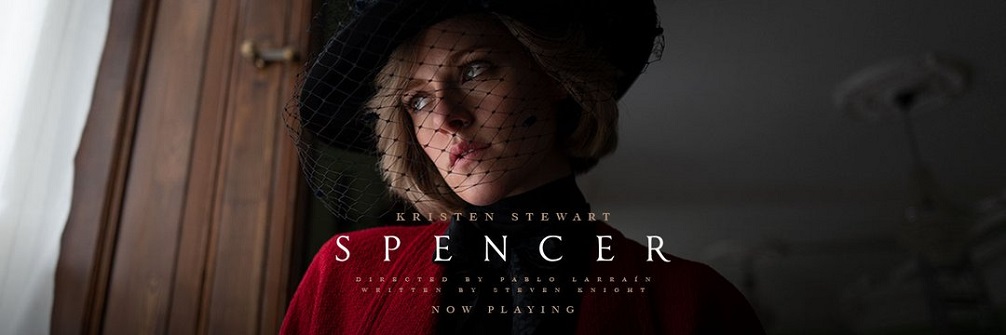
Spencer and all the images you see in this review are owned by Neon

Directed by Pablo Larrain

The Royal Family gathers together for Christmas, but Diana (Kristen Stewart) has been struggling in recent years to keep up a brave face in the presence of her extended family; especially since the rules and traditions of the Royal Family are not the easiest thing to adhere to, even for someone in the best of mental health.  Her husband Charles (Jack Farthing) is fed up with her change in behavior, and while her sons (Jack Nielen and Freddie Spry) are much more sympathetic, even they have trouble reconciling this rift between their mother and the rest of the family.  Will Diana be able to continue on like this, or will this be the Christmas that changes everything?

Every once in a while I’ll see a movie that I should like a lot more than I actually do.  I can see how they approach interesting themes with a great deal of substance and depth, I can tell that the cinematography is very well done while also reinforcing the themes, and I can appreciate the acting as well as the dialogue in the script.  Yet even with all these elements working together, I’m left rather nonplussed; engaging with it on an intellectual level but just not feeling enough passion or excitement to walk away satisfied.  To elaborate on the film’s strengths, we have an excellent performance from Kristin Stewart who has to carry this movie on her shoulders, the overwhelming weight of the literal crown on her head is palpable in the way that she carries herself and how she reacts to situations around her.  The idea of feeling sorry for someone who is literally royalty is not exactly an easy feat, especially with wealth inequality and unrepresentative government indifference being such hot button issues these days, but it makes several smart choices with its narrative and style that it keeps those real-world implications from getting in the way of this one character’s story.  It’s uncomfortable and deeply saddening at points with the machinery of the Monarchy proving impenetrable (no one thing can be blamed for each and every stuffy decision and all the soulless pieces of it perfectly fit to reinforce each other), but it also finds catharsis in Diana’s struggle for freedom and peace and never gets so dark as to be an unbearable tour of misery.  Still, despite all these strong elements to the movie, I still felt detached from it all; so what about it is keeping me at bay?  Well, I think the answer is in what I just said, which is a feeling of detachment.  I don’t know the first thing about Princess Diana other than she died at some point while I was still in kindergarten, and the movie is in no particular hurry to provide answers to that question.  To the script’s credit, they do provide enough context and details for this particular character to work (meaning they could easily have swapped her out for a fictional character in a made-up kingdom) but the script turns out to be a doubled-edged sword as it does a lot more telling than it does showing.  We understand Diana’s ennui and how she is reacting to everything around her, but I still felt like I was observing her from afar instead of getting inside of her head.  This may also just be a flaw on my part, being rather unintuitive or perhaps a bit callous, but the lack of context also left me unclear as to what actual consequences there would be if she just stopped playing along, and the big dramatic ending of the movie kind of loses something when you realize that Diana isn’t actually risking or giving up anything to get to where she needs to go.  Sure, there’s the shame and disdain of her royal family that burrows deep into her psyche and are perhaps just as effective chains around her as the threat of genuine consequences would be, but it definitely feels like a critical piece of the puzzle is missing here.  On top of that, the movie is very sparse with long shots of mundane action and a very straightforward score.  None of it is bad per se, but there’s not a lot to perk your interest as far as spectacle; not in the sense of explosions or CG monsters, but I doubt it would have been too out of place for some dynamic camerawork or even some creative editing.  This means the movie relies almost entirely on its script and performances which, once again are very good, but to me, a movie about someone’s psychological issues should use all the tools at the filmmaker’s disposal and it never seems to want to go past a certain level of offbeat imagination.  I’m still gonna give this a recommendation if for no other reason than Stewart’s deeply heartbreaking performance, but it hews a bit too close to the cliché of the stuffy –drawing-room film than I would have expected from the studio that gave us I, Tonya.  Perhaps expecting that level of creative verve would have been inappropriate for a movie whose themes are about the stifling conformity of the aristocracy (especially one that’s ostensibly based on real people), but a few more flourishes here and there wouldn’t have hurt!

3 out of 5
Continue reading “Cinema Dispatch: 2021 Catch Up (Part 1)”
