Good Fortune and all the images you see in this review are owned by Lionsgate
Directed by Aziz Ansari
Catch-up month continues as I dutifully ignore new releases until I feel I’ve seen enough of 2025 to make my year-end lists, and while this comedy may have some big name stars involved, you’d be forgiven if it slipped past you as it did me. I knew it was coming out and had every intention to make a pilgrimage to my local multiplex, but I just never got around to it and had to wait for the inevitable VOD release. A sad fate that many movies have had to endure, but should I be truly repentant for missing its theatrical run, or was it always destined to be a better watch in the comfort of our homes? Let’s find out!!
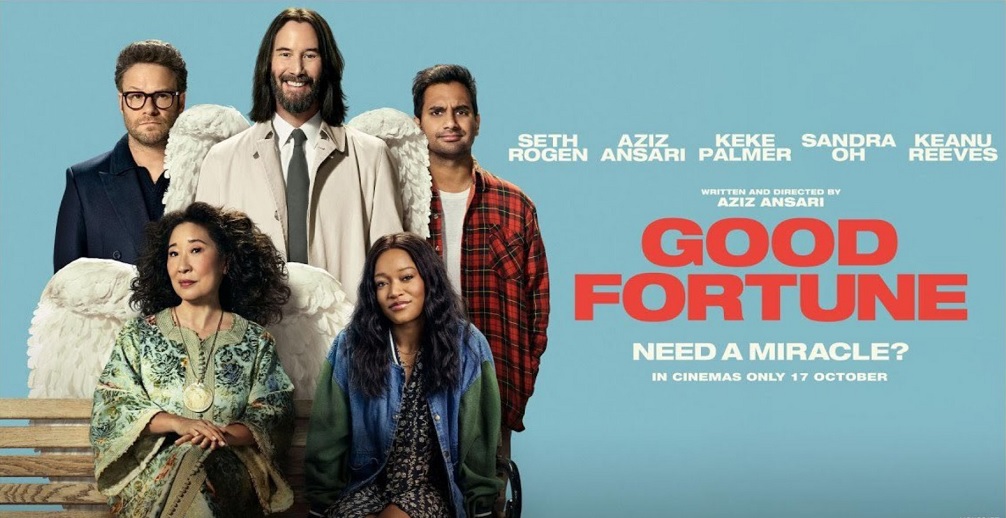
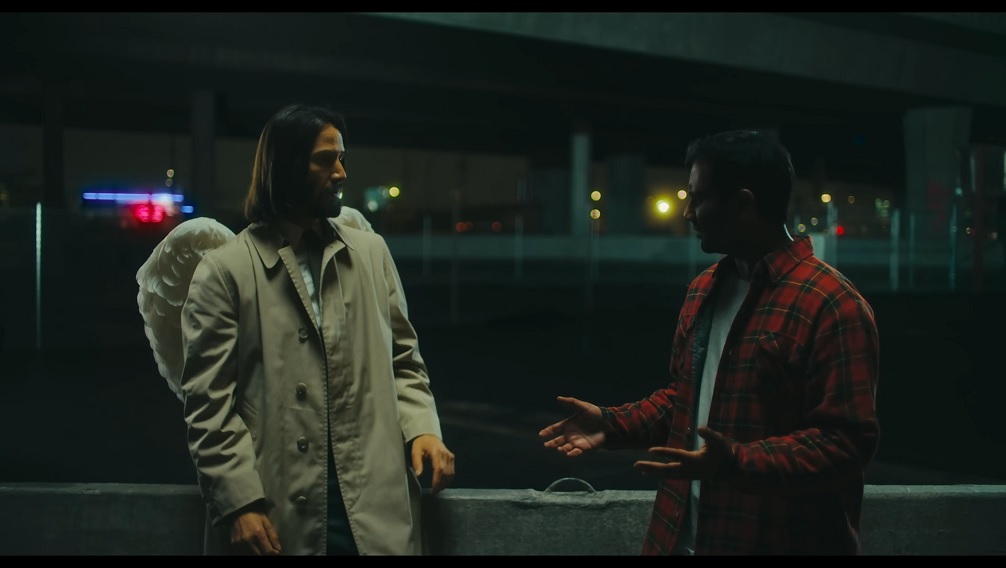
In the heart of Los Angeles, whose name turns out to be much more literal than previously thought, a down on his luck guy named Arj (Aziz Ansari) catches the eye of Gabriel (Keanu Reeves); a lower Angel who typically only helps people who are texting and driving but sees something in Arj that needs fixing. He’s living out of his car, he’s running around the city doing crappy jobs, and while he likes the woman at the hardware store who’s trying to start a union (Keke Palmer), he can barely afford food for himself; much less a date where both parties would be expected to eat. After a particularly rough day where he is unceremoniously fired by tech bro Jeff (Seth Rogan) from the only good job he had, Gabriel tries to intervene and show Arj what makes his life worth living. It doesn’t quite go according to plan, however, as it turns out that Arj’s life isn’t going to get much better than it is now, and things only get worse when Gabriel has the bright idea to do what is known as a Switch-A-Rooney where he makes Arj and Jeff switch places. Not a bad trade for Arj all things considered, but Jeff isn’t too happy about it and Gabriel’s boss (Sandra Oh) is less than thrilled at his loose-cannon behavior. Will this new life for Arj prove to be more of a curse than a gift, which is what Gabriel was trying to prove in the first place? Can Jeff survive the horrors of hustle culture and perhaps learn a little something about himself in the process? Seriously, what was Gabriel’s plan when he gave Arj everything he could ever want? Unless Jeff was about to be indicted or assassinated, it’s hard to see much of a downside.
Whenever I feel the urge to put a couple of reviews together, I at least try to find some sort of thematic connection between them, and I may have found the most specifically connected double bill that could possibly exist. Both films are directed by a Safdie brother, both are character pieces about sports figures, and both have stars of billion dollar franchises but ended up with mediocre box office returns. Oh, and both were released by the same studio, if there weren’t enough similarities already. It’s like they had a bet to see which one could make the better movie with more or less the same premise and resources, which I suppose means that it falls upon me to call this match and raise the arm of the winner! Will it be the intense kid from Dune, or Dwayne “The Tooth Fairy” Johnson who takes home the gold!? Let’s find out!!
.
Marty Supreme
Marty Supreme is owned by A24
Directed by Josh Safdie
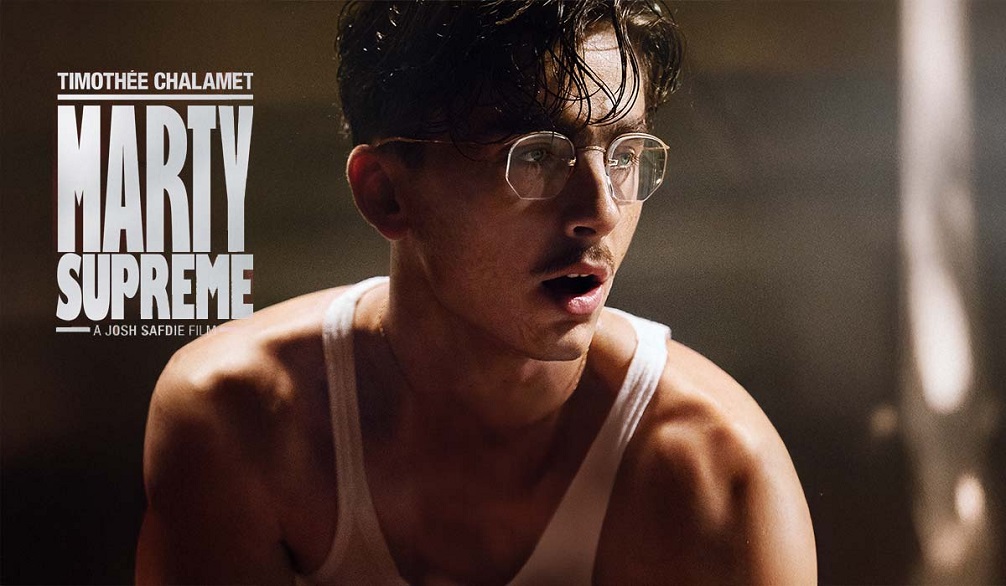
Marty Mauser (Timothée Chalamet) may not look like much, but underneath the scrawny frame and terrible mustache is a world-class table tennis player with trophies and prestige under his belt, but still barely scraping by and has to pull scams so he can fund his trips to international tournaments. After a devastating defeat to an up-and-coming Japanese star (Koto Kawaguchi), Marty is more determined than ever to be at the next tournament and claim the top spot from his new rival. Of course, it doesn’t help his case that he scammed the International Table Tennis Association for a luxury hotel room, so on-top of his usual hustles to make it to the next tournament, he has a neigh unpayable bill to the organization that needs to be paid in full before he can compete. Tack onto all of this his strained relationship with his family and a girlfriend (Odessa A’zion) who’s about to give birth, and Marty is stuck with more problems than he can shake a ping-pong paddle at. His only hope might be from a local ink pen magnate (Kevin O’Leary) and his wife (Gwyneth Paltrow), but since Marty is sleeping with her on the side, it might prove an even more fought situation than even he’s capable of navigating. Can Marty fulfill his dream without destroying his life in the process, and will he even give up that for an opportunity to be the best in the world?
The Safdies have been two of my favorite filmmakers for some time, and their last collaboration, Uncut Gems, was an absolute treasure. This film, on the hand, is not nearly as shiny as Josh Safdie was not able to recreate that success despite how obvious it is that he’s trying to. Their distinct style has been carried over here, as once again we are following a driven individual as he fumbles his way through an endless and chaotic series of vignettes in pursuit of whatever they think will fix everything that’s gone wrong in their life. While I found this quality both horrifying and captivating in Uncut Gems and Good Time, it wore me down seeing it repeated here, and to my mind, he needn’t of bothered as he was already making an interesting movie well before he started to indulge in his usual tropes. The table tennis matches are stunning to watch, with trick shots and big swings to convey just how high a level these players are, and the pacing of the matches leave you at the edge of your seat anticipating the next volley with breathless anticipation. A movie that stayed focused on the tournaments would have been amazing in its own right, but I suppose Josh Safdie likes his characters to frantically run through the streets of New York City, and so a majority of the movie is about watching him make bad decisions instead of watching him play table tennis. I appreciate that the personal struggles are necessary for the payoff of the ending to be worth it, but where the previous Safdie films felt intense and ran at a breakneck pace, this one ends up being repetitive and overlong; failing to capture the bleak grittiness of Good Time or the comedic tragedy of Uncut Gems. A shorter runtime would have helped to at least keep the pacing from dragging, but it also fails to make Marty and his struggles meaningfully sympathetic. It’s hard to avoid the fact that the first problem he runs would have been the easiest to overcome, especially given just how far he’s willing to go later in the film, and as good as Chalamet is in the role, I just couldn’t connect with him when he wasn’t holding a paddle. The takeaway here is not that this is a bad movie as even a poorly done Safdie film is still better than most filmmakers on a good day, but the heart is missing where it’s needed most, and a strong ending that returns to the table tennis action does only so much to bring me back onboard. As much as I liked watching them hit balls back and forth, I’m not sure if it was worth the two hours of misery and anxiety to get there.
My End of 2025 Catchups will still be ongoing well into the New Year, which is perfectly fine for me, as January looks to be the usual crop of mid-range horror movies and previous year stragglers. Today is what I like to call the Austin Butler Downer Double Feature, as both films are movies that had me feeling rather sad despite Austin Butler being on hand to try and liven things up. I suppose it’s a shortcoming of mine as a critic that depressing movies have to work much harder to convince me of their quality than goofy ones, and being presented with two films by notoriously grim directors was definitely a challenge. Can either of these depressing films by depressing filmmakers manage to get a thumbs up from yours truly? Let’s find out!!
.
Caught Stealing
Caught Stealing is owned by Sony Pictures Releasing
Directed by Darren Aronofsky
Hank Thompson (Austin Butler) isn’t someone you’d look at twice if you passed him on the street. He’s a bartender in New York City, he has a crappy apartment in the Lower East Side, and his good looks and charming personality do just enough to cover for his obvious alcoholism. When his neighbor (Matt Smith) asks him to watch his cat one weekend, it seems like just another meaningless event in his meaningless life, but then gangsters start chasing after him, the cops get involved, and the few friends he has left in this world start getting mixed up in whatever mystery he finds himself at the center of. With few people to turn to and fewer clues as to what’s even going on, can Hank outrun this waking nightmare as faster than he did from his own dark past, or has the universe decided that now’s the time to pay the piper for all the ways he managed to screw up his life?
I probably should have known better than to expect a fun movie out of the most depressing filmmakers of our generation, but the trailers suckered me in with a silly premise and goofy characters in what looked like a lost Guy Ritchie joint, so I took the gamble on him lightening up for once. Sure enough, the finished product is undeniably an Aronofsky movie which means a lot of sad things happen, and frankly it was a real struggle to get through. What’s at least interesting about this movie, though also why it doesn’t work as well as some of his better films, is that he does seem to be trying to break outside his comfort zone with larger than life characters and the farcical plotting, but he’s simply ill-equipped for this kind of material and fails to merge it with his usual sensibilities. Someone like the aforementioned Guy Ritchie, or even Vince Gilligan, could have juggled the disparate parts of this story and wrangled them into something coherent, but they both have backgrounds in comedy which Aronofsky clearly does not. We flip wildly between tragedy and humor in a way that fails to take full advantage of either, with the darker elements feeling gratuitous and the lighter moments robbing our characters of any consistency or depth. Austin Butler, for all the charm and charisma he brings to this, can’t find a consistent emotional wavelength to explore because the script has him running from one plot point to another at breakneck speed. He’s given one scene to express his sadness over a bad thing happening before he’s back to spinning lies, crafting schemes, or cracking jokes, and while he’s good at all of those things, having him rush through it in such quick succession leaves him feeling rudderless and without much of an arc to go through. The script is based on a book which is always a double-edged sword for filmmakers, and I’m guessing the pacing between scenes worked much better on the page than trying to cram it all on screen, but even taking that into consideration, I still think the blame falls squarely on Aronofsky’s shoulders. I give the man credit for at least attempting to tell a few jokes and I think the narrative did cater to his sensibilities as a filmmaker, but he’s gonna need a little more practice before he can successfully make us laugh at a clown and then jab him in the throat to watch as the blood slowly pools around the floor.



 The Reviewers Unite