
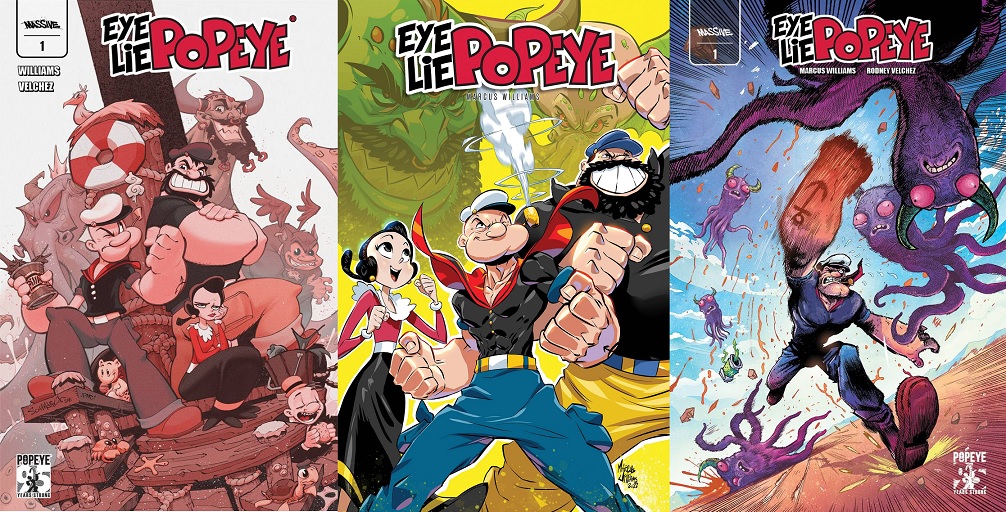
Eye Lie Popeye and all the images you see in this review are owned by Massive Publishing and King Features
Written and drawn by Marcus Williams
Popeye shares that fate of many of his early animation peers in that they have a brand and legacy that enough people seem to care about, and yet no one seems to know what to do with him. Popeye is one of my favorite cartoon characters and the Robert Altman movie is an absolute classic, but it’s never been much more than a nostalgia property in my lifetime. The movie was over forty years ago, and the best we’ve gotten since then is the NES game, which was still well before my time. As far as I’m concerned, the only relevant thing in the Popeye canon since the turn of the millennium was that excellent episode of Death Battle where he kicked Saitama’s butt, and it seems to have tapped into something about the character given that this comic is very much inspired by the same ridiculously over the top Shonen anime that One Punch Man is a part of. Still, that worked as a one-off video for a couple of guys on YouTube. Is there enough juice in that lemon, or spinach in that can, to carry a series like this? Let’s find out!!
Our story begins with a plucky reporter named Judy P’Tooty who is determined to find out just how the legendary sailor Popeye lost his eye. I guess this proves what a fair-weather fan of Popeye I am, as I always thought he was just squinting, but apparently he’s missing an eye and everyone and their mother is ready to tell Judy how it happened. As a framing device for a first issue, this works well enough as we hear fantastical stories from Olive Oyl, Bluto, and Wimpy that perhaps are light on truth but reveal pertinent details about the cast. No one is going outside their established characters as Olive carries a torch for Popeye, Bluto is a mean-spirited blowhard, and Wimpy is fastidious about his hamburgers, but given how unlikely it is for young readers to know the finer details of these characters, it’s important to get everyone up to speed.
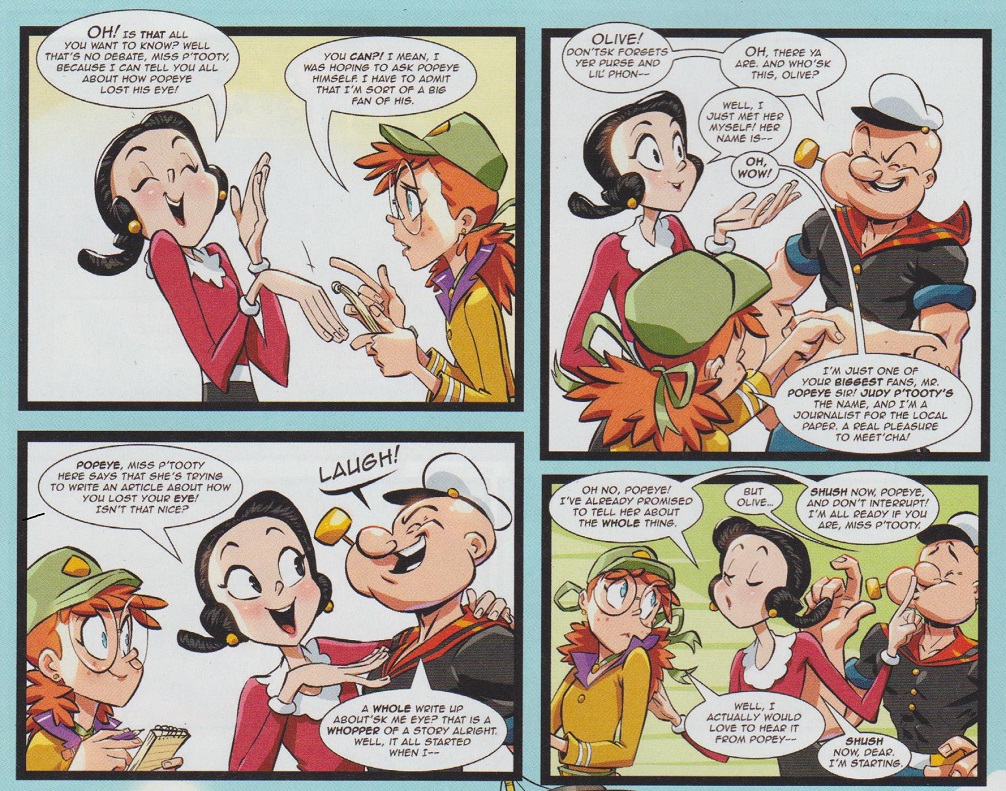
The best character by far has to be Bluto who is taking up the Vegeta role with gusto, but while I do love his bluster and misplaced egotism, there are moments of genuine heart that shine through just underneath the bravado that gives him much more depth than anyone else in this issue, but that’s jumping ahead a bit. It turns out that Judy is not a reporter, but a disciple of the Sea Hag; the primary antagonist for Popeye whenever the comic strips or cartoons wanted to go a bit more fantastical. Their plan was to find the location of Popeye’s missing eye which I guess is a source of great power for some reason that I’m sure will be explained later, and to surreptitiously abscond with the town’s supply of canned spinach so they can summon a jacked merman to beat the snot out of him if he didn’t already give up the location of the eye. While the stories we heard from the peanut-gallery had a fair amount of action in them, this is where the book gives you the hard sell on what to expect going forward. Bluto offers to take him on first, showing himself not to be a coward and willing to fight to protect others, at least as long as he can show off doing it, but Merman proves to be too strong a fighter and leaves him in a crater which just leaves Popeye to finish the job.

The artwork is fantastic, with strong character designs and a command of the action that’s genuinely exciting to see play out. However, the book borrows a little too much from the big box of Shonen clichés and gears start to grind between the goofy fun of Popeye and the self-seriousness of the action anime that inspired this. To put it simply; seeing Popeye’s fists turn into anvils before punching Bluto into the sun? That’s fun. Having someone explain for three panels how he’s a lost member of the Rubber-Hose tribe whose unique metabolism allows him to both reshape and harden his limbs, is not. Popeye as a comic strip, and especially as a cartoon, never concerned itself with power levels or believable action. Instead, it was absurdist and relied on a level of cartoon logic that doesn’t translate itself to being taken seriously, and yet because it’s what people associate with Shonen, we get a page of the Sea Hag laying out Popeye’s power set in a way that just killed the mood for me. I suppose I’m only speaking for myself here as I’ve never been too hung up on power levels in action anime either, but for Popeye it just feels out of place and like we’re putting the cart well before the horse as we’ve barely even started this book yet are stopping the action to throw out some definitions.

It also makes a pretty sizable mistake when we learn that the Merman is actually a Sea Nymph under the Sea Hag’s spell, and Popeye refuses to continue fighting her. Credit where it’s due for Marcus Williams pulling out the deepest of deep cuts by giving us Susie the Sea Nymph, a character I didn’t know existed in the Popeye canon until I looked it up after reading the issue, but I’m not a fan of male protagonists in action stories having a blanket policy against fighting women. I suppose you could argue that it fits with the retro anime aesthetic that it’s going for, but I don’t think anyone looks back fondly on those shows that took that issue head on. It’s simply infantilizing for Popeye or any anime protagonist to refuse to fight women just for being women, no matter how strong they are. He manages to work around this issue by coming up with a clever way to drain her of her power and free her from the Sea Hag, but I feel like we could have gotten to that point without the retrograde gender politics.
The question to answer is whether there’s enough novelty in turning Popeye into a Shonen series to sustain a book? After this initial issue, I’d say the answer is yes, but not without a few tweaks to the setup. There’s definitely more than enough overlap between Popeye and action anime for this reimagining to make sense, but I feel that it needs to have a little more of its own identity rather than relying on the genre clichés; especially when the appeal of Popeye buts up against it. I’m certainly interested to see where this goes and what other fun tidbits from the greater Popeye lore they can shove in here, so let’s leave this at cautiously optimistic. What I’m less optimistic about is the title, which is somewhat awkward to say and doesn’t really convey what this book is about. What, was Super Popeye or Popeye Z too on the nose?


 The Reviewers Unite